
Facebook advertising remains one of the most effective ways to reach and convert your ideal audience. When campaigns are structured correctly, they don’t just generate clicks — they generate real enquiries and measurable growth.
Facebook gives you access to a large and highly active audience, but performance depends on how precisely that audience is defined.
Many Facebook Ads campaigns rely on broad targeting and expect the platform to optimise results on its own. In most cases, this leads to inconsistent performance and rising costs.
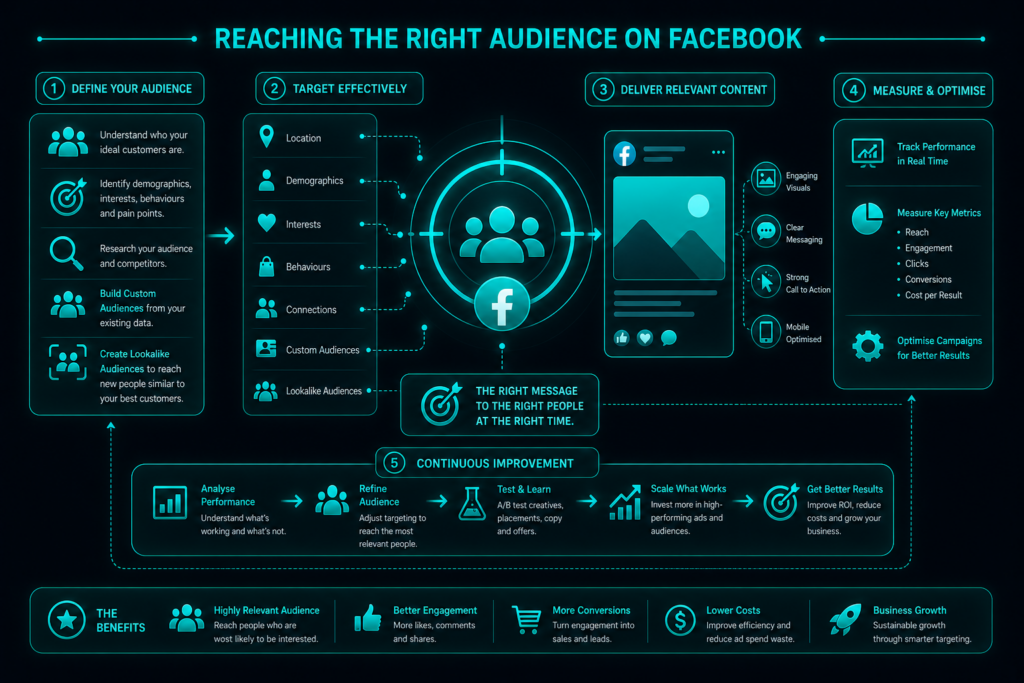
Stronger campaigns are built around clearly defined audience segments. Location, interests, behaviour, and previous engagement all play a role in shaping how ads are delivered.
For businesses in Melbourne, this level of targeting is critical. It ensures ads are shown to users who are more likely to engage and convert, improving both efficiency and lead quality.
When targeting is aligned properly, campaigns become more predictable. When it isn’t, budgets are spent without producing consistent outcomes.

Creative is one of the main factors that determines whether a Facebook Ads campaign performs.
Unlike search platforms, users are not actively looking for a product or service. Ads need to capture attention quickly and communicate value clearly within the feed.
Simple, relevant creatives tend to outperform ads that are overly complex or unclear. The objective is to present something that fits naturally within the platform while still standing out.
Creative is not static. Performance data is used to identify what resonates with your audience, and campaigns are adjusted accordingly to maintain results over time.
This is where a strong Meta Ads strategy becomes important — ensuring your ads perform consistently across Facebook and Instagram placements. For campaigns focused specifically on Instagram growth, explore our Instagram advertising services.
Campaign setup has a direct impact on how efficiently Facebook delivers ads.
Without a clear structure, audiences can overlap, budgets can be distributed unevenly, and performance becomes difficult to manage.
A structured Facebook Ads account separates audiences, objectives, and spend. This allows for clearer performance tracking and more controlled optimisation.
When campaigns are organised correctly, it becomes easier to identify what is working and where improvements need to be made.
For businesses running multiple digital channels, aligning Facebook campaigns with your broader Google Ads services and SEO services ensures consistent visibility across both paid and organic channels.
Scaling is where Facebook advertising delivers long-term value.
Increasing budget alone does not guarantee better results. In many cases, it leads to higher costs without improving performance.
Effective scaling is based on expanding areas that are already delivering results. This includes extending high-performing audiences, adjusting budgets gradually, and removing inefficiencies early.
For Melbourne businesses looking to grow, this creates a more stable and predictable approach to paid social advertising.
Campaigns grow without losing efficiency, and performance remains consistent over time.
Facebook Ads campaigns can begin generating traffic shortly after launch. Consistent performance improves as campaigns are refined over time.
Yes. Facebook Ads Manager allows campaigns to run across both Facebook and Instagram placements as part of a broader Meta Ads strategy.
Audience targeting, ad creative, and campaign structure are the three main factors that influence performance.
Broad targeting, unclear messaging, and poor campaign structure are the most common reasons for rising costs.
Campaigns should be reviewed regularly and adjusted based on performance data to maintain efficiency.
Facebook Ads works best for businesses with a defined audience, clear offer, and structured campaign approach.