Two businesses can offer similar services in the same suburb and still have very different reputations online. One may be mentioned by local organisations, featured in community news and backed by a website that shows real work. The other may have little information beyond its own listing.
It’s tempting to say Google “trusts” one business more. But Google doesn’t publish a local trust score or a checklist of trust signals. The closest term in its local ranking guidance is prominence: how well-known a business is. Google says prominence can be informed by things such as links to a business and its reviews, while noting that the details of its ranking system are private.
So what can a business do? Focus on building a reputation that customers and the wider web can verify.
Build a reputation beyond your own website
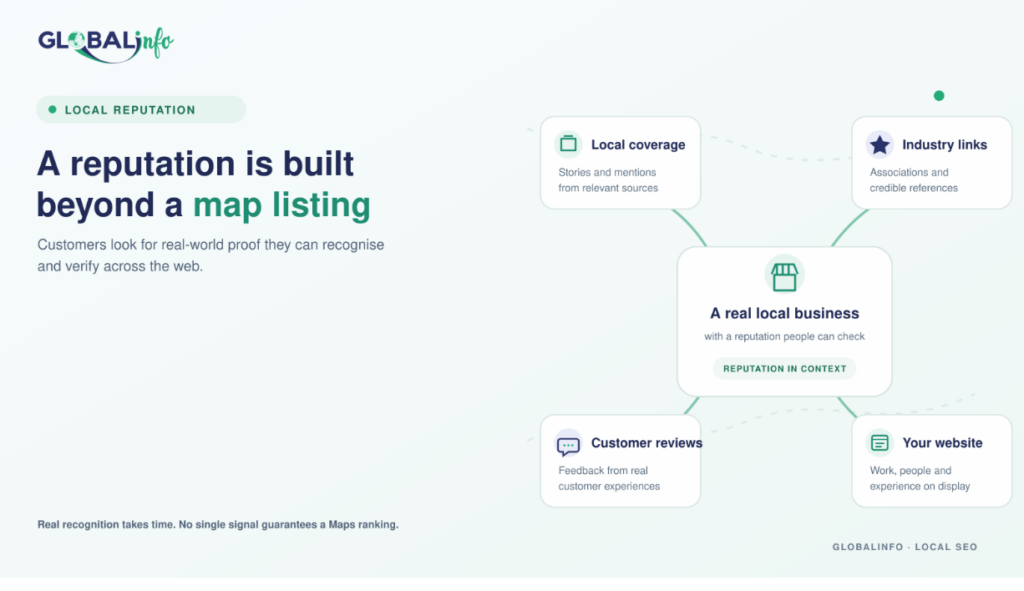
Your website and Business Profile are important places to explain who you are. Your reputation also takes shape elsewhere: in local news, industry publications, association directories and community organisations.
A genuine mention from a relevant local source can help people discover your business and learn what it does. For example, an industry association might list a Melbourne trades business, a local publication might feature it, or a community group might recognise it.
These examples are sensible ways to build a real-world reputation; they aren’t a guaranteed ranking recipe. Google’s guidance identifies links as one source of prominence, but it doesn’t publish a formula for how individual mentions are weighed.
Earn links that make sense for your business
A link is more meaningful when it comes from a genuine relationship or useful piece of information. A link from a trade association, local event partner or relevant publication makes more sense than one from an unrelated website that exists only to sell links.
Look for opportunities that reflect work your business is already doing:
- Contribute useful expertise to an industry publication.
- Sponsor a community event your business genuinely supports.
- Join an association relevant to your profession.
- Share a project or local initiative that another organisation may want to reference.
The goal is to create useful connections and recognition, not to collect links for their own sake.
Give people something real to verify
If someone hears about your business elsewhere, they may visit your website to check the details. Make it easy for them to understand what you do and decide whether to contact you.
Useful trust-building content might include:
- Examples of completed work
- Clear information about your team and experience
- Real qualifications, memberships or awards
- Case studies that explain the customer’s problem and your solution
- Contact information that makes it easy to reach the business
This isn’t a promise that adding a particular page or badge will improve Maps rankings. It shows potential customers there’s a real business behind the listing and gives other organisations accurate information if they mention you.

Let reviews reflect real customer experiences
Reviews help customers get a sense of what it’s like to work with you. Google also says that review numbers and positive ratings can help a business’s local ranking.
Ask customers for honest feedback, and don’t try to script what they say. A natural review that describes a real experience is more useful to future customers than one written to include particular keywords.
Google prohibits fake or incentivised reviews. Violations can lead to reviews being removed or restrictions being placed on a Business Profile.
Keep your claims accurate
A strong reputation is easier to maintain when the details are true and up to date. If your website says you offer a service you no longer provide, or an old profile describes a previous location, a customer may lose confidence when they discover the mismatch.
Review the information customers are most likely to rely on: your services, locations, team credentials and contact details. Correct the underlying facts wherever they’re wrong. Small formatting differences aren’t the same as conflicting information, so focus on accuracy rather than making every listing look identical.
Don’t confuse related concepts with confirmed Maps signals
Terms such as E-E-A-T, branded searches, calls and direction requests often appear in local SEO advice. They may be useful areas to think about when assessing your wider online presence, but avoid presenting them as confirmed Google Maps ranking factors.
Google describes E-E-A-T in the context of its content-ranking systems and says E-E-A-T itself is not a specific ranking factor. That doesn’t make experience or expertise unimportant to customers; it means the concept shouldn’t be presented as a direct Maps ranking signal.
A practical place to start
Instead of chasing every possible “trust signal,” ask:
- What would a new customer look for to check that we’re credible?
- Which relevant organisations or publications already know our work?
- Does our website show real examples, experience and accurate details?
Those questions can help you find gaps in your online reputation and choose useful next steps. None guarantees a ranking, but each can make your business easier for customers to understand and evaluate.
The takeaway
Google doesn’t offer businesses a public trust score to optimise. It describes prominence as one part of local ranking and says information such as links and reviews can contribute to it. The practical work is to earn genuine recognition, make your experience visible, and keep your business information accurate.
If you’d like help reviewing how your business is represented online, explore GlobalInfo’s local SEO services or book a strategy call.
Frequently asked questions
Does Google give local businesses a trust score?
Google doesn’t publish a local trust score. It describes prominence as one of the main factors in local results and says prominence can include information such as links to a business and its reviews.
Can local links help a business appear more prominent?
Google says links to a business can be one source of information used to assess prominence. A relevant link can also help customers discover your business, but no specific link guarantees a higher Maps position.
Is E-E-A-T a Google Maps ranking factor?
Google explains E-E-A-T as a way to think about qualities of helpful content. It says E-E-A-T itself isn’t a specific ranking factor, so it shouldn’t be described as a confirmed Maps ranking signal.
Should I pay for reviews or offer customers a reward?
No. Google prohibits incentivised reviews. It may remove reviews or restrict a Business Profile if it determines that the policy has been violated.